
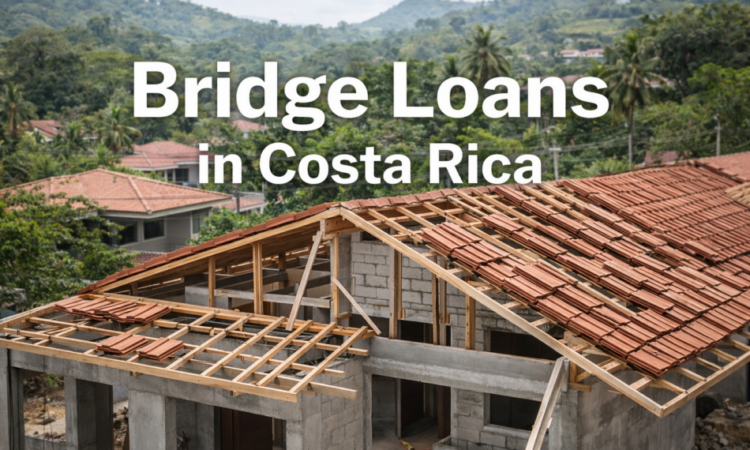
What Are Bridge Loans in Costa Rica? Structure and Lender Considerations
Bridge loans in Costa Rica are typically structured as short-term, real estate–secured financing solutions designed to support transitional scenarios. From a lender perspective, the emphasis is placed on collateral quality, conservative leverage, and enforceable documentation rather than speed alone.
Bridge lending can serve practical capital needs, but outcomes depend on structure, loan-to-value, exit planning, and execution discipline.
What Is a Bridge Loan in the Costa Rica Context
A bridge loan is generally a short-term loan secured by real estate that provides temporary financing while a borrower transitions between events such as property sale, refinancing, construction completion, or capital restructuring.
Unlike long-term mortgage structures, bridge loans are often structured around clearly defined timelines and repayment expectations.
Collateral and Loan-to-Value Considerations
Collateral remains central in bridge lending. Conservative loan-to-value is commonly applied, often around fifty percent or less, subject to underwriting and asset quality.
Lower leverage may support stronger capital protection assumptions. If loan-to-value increases, pricing and structure may adjust accordingly.
First-Lien Positioning and Enforceability

When structured that way, bridge lenders are typically placed in a first-lien position against the property. This ranking supports enforceability and recovery priority.
Proper legal review, registration, and documentation execution are essential to maintaining lender protection.
Indicative Pricing and Duration
Bridge loans are commonly shorter in duration than traditional mortgage solutions. Pricing discussions at the loan level may occur in the low-teens range, indicative only, subject to underwriting and not guaranteed.
Because bridge lending involves transitional scenarios, repayment assumptions must be realistic and clearly documented.
How Bridge Loans Compare to Other Loan Structures
Bridge loans differ from equity loans secured by long-held property value, as well as construction financing tied to staged disbursements. Commercial real estate loans may involve longer-term income analysis and structured amortization.
For larger capital needs, shovel-ready projects and project or development financing may also be relevant. Both can involve multi-million-dollar structures, and if one fits, the other may also fit depending on readiness and execution planning.
Fund-Management Partnerships and Bridge Lending
GAP seeks partnerships with professional fund managers and capital allocators in the United States and internationally who manage retirement funds, pension portfolios, and private investment capital.
If a fund allocates ten million, twenty-five million, or fifty million US dollars or more, capital may be deployed into secured Costa Rica real estate loans, including structured bridge scenarios. Portfolio-level return targets are typically discussed in the approximate eight to nine percent range to end clients, indicative only, subject to underwriting and deal structure, and not guaranteed.
Costa Rica’s stable democracy, established property rights, and transparent secured-lending framework support structured bridge lending when combined with disciplined underwriting.
Risk Management in Bridge Lending

Bridge lending requires realistic exit planning, conservative collateral assumptions, and enforceable structure. Transitional financing may carry timing risk, which is mitigated through disciplined loan-to-value and documentation clarity.
Returns are not guaranteed and depend on asset quality, leverage, and execution.
Related Real Estate–Secured Lending Categories
Bridge lending is often evaluated alongside equity loans, construction financing, commercial real estate loans, shovel-ready projects, and project or development financing.
Frequently Asked Questions
Are bridge loans in Costa Rica long term?
No. Bridge loans are typically structured as short-term financing solutions with clearly defined repayment expectations.
Is first-lien positioning required?
When structured that way, first-lien positioning is typically required to support enforceability and capital protection.
Are returns guaranteed?
No. Returns are indicative only and depend on structure, collateral quality, and execution discipline.
What loan-to-value is commonly used in bridge lending?
Loan-to-value is often structured conservatively, commonly around fifty percent or less, subject to underwriting.
If this article includes AI-generated images, they are for illustrative purposes only and do not represent a specific borrower, property, or active transaction.
Article by Glenn Tellier (Founder of CRIE and Grupo Gap)
Sign up to start investing today!
